


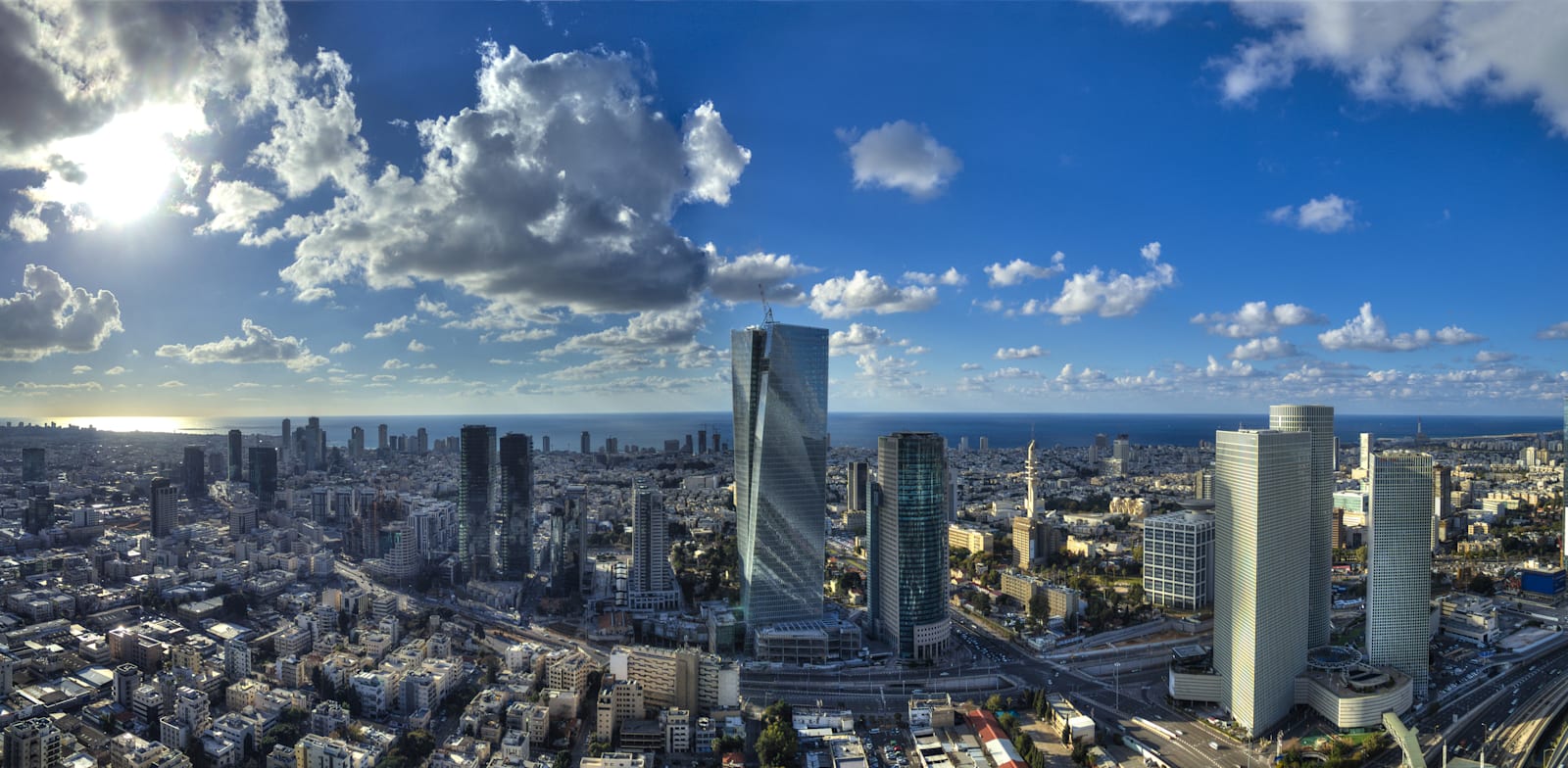
Previous 7 days, something occurred that could significantly improve Israel’s city ecosystem: The National Planning and Developing Commission approved Amendment 4 to Tama 35 (the Nationwide Outline Program) which aims to boost household density in urban places considerably. The go is part of a revised overarching concept between urban planners who now keep that Israeli towns must be far more densely populated than they are now.

Globes evaluations the modification and considers what it will necessarily mean.

What primary coverage factors had been raised this week about the household density in city places challenge?

Tama 35 was formulated by the Planning Administration as a tool for employing the provisions of the 2040 strategic housing strategy, which set a concentrate on for building of 1.5 million new housing models. It was made the decision, thus, to raise residential density to the utmost allowable restrict, to the level of doubling it.

For example, if the approach initially established a density limit of up to 12 housing units for every dunam (a person-quarter acre) in Jerusalem, and up to 16 housing units for each dunam in Tel Aviv, the modification permits density of up to 30 housing units for every dunam in cities with more than 500,000 persons, and in main metropolitan places.

The amendment also involves a directive that any system of a lot more than 100 housing models will allocate at the very least 50% of the place for household use.

The amendment would make one more critical provision: household density will be a gross calculation, taking into account all the areas of the prepared locations and not just household plots. This will permit for assortment in construction kinds – substantial-rises alongside perimeter block housing, for illustration – offering equipment to build a more flexible arranging actuality for each spot.

So why really should Israel’s cities grow to be much more crowded?

According to the Organizing Administration, the regular household density in Athens is two times as significant as the regular density in Jerusalem and Tel Aviv. In Paris it is three occasions greater, and in Barcelona 4 moments bigger.

Planning Administration director standard Dalit Zilber, who has been seeking for various many years to encourage greater residential density, thinks it will permit for the generation of a energetic city place throughout the working day, though maximizing accessibility to community transportation and municipal expert services. She terms the accredited amendment, “A revolution in reorganizing the urban space in a way that will improve high quality of life for inhabitants,” the rationale currently being that higher density sales opportunities to a improve in the complete planning notion for a city, encouraging mixed use on a huge scale, facilitating the style of more efficient general public transportation programs, and for that reason also encouraging walking and a lot less use of non-public cars and trucks. The finish consequence will be richer and additional diverse town streets.

A booklet printed by the Ministry of Housing, “Diversification of Design in Different Household Densities,” cites Zero () great deal line design as an solution for escalating residential density. This strategy of setting up up to the edge of the residence line is not frequently noticed in Israel but is incredibly prevalent in towns abroad. Zero great deal line construction lets for decrease-increase structures although nonetheless affording large density, and has a further advantage: the structures shade the road.

Are we very likely to see lots of extra towers?

The Scheduling Administration and the Ministry of Housing have stated consistently that growing residential density does not essentially signify increasing the number of substantial-rise properties, which are costly and intricate to keep. The intention is to encourage a mixture of various styles of design: towers, common household buildings, and even homes with gardens in some scenarios.

For case in point, 500 housing units in a new community can match into 5 25-story towers of 100 flats each individual. But they can also be divided differently. For illustration, one particular 25-story tower up coming to 8 decreased-level properties, or even two towers, two ten-story structures, furthermore flats developed above general public services and/or professional flooring, in a combined-use development.

How will amplified density influence parking?

A suggestions booklet revealed by the Ministry of Housing states that, “A very low parking ratio (significantly less than one particular parking space for each condominium) permits for the development of rather higher-density design kinds, without having an high-priced parking resolution and without the need of the need for superior-increase development, for the reason that the ‘built-up’ parts (the included locations of the making) can be enlarged.” The Ministry of Housing also notes that preparing an more underground parking amount can double the density without having introducing a lot more floors, and emphasizes that the larger sized the home size planned for development, the easier it is to system underground parking “with all of its factors and concentrations.”

When will the change in Tama 35 go into outcome?

Given the current political reality, it’s hard to say. By approving the amendment, the National Planning and Building Commission effectively recommended that the government should approve the details of the proposed amendment, which includes the items listed above. This is an important stage in the process of changing the National Outline Plan However, because of the instability of the coalition, it’s unclear when the matter will be presented for discussion in the government and final approval.

Published by Globes, Israel business news – en.globes.co.il – on May 19, 2022.

© Copyright of Globes Publisher Itonut (1983) Ltd., 2022.


